





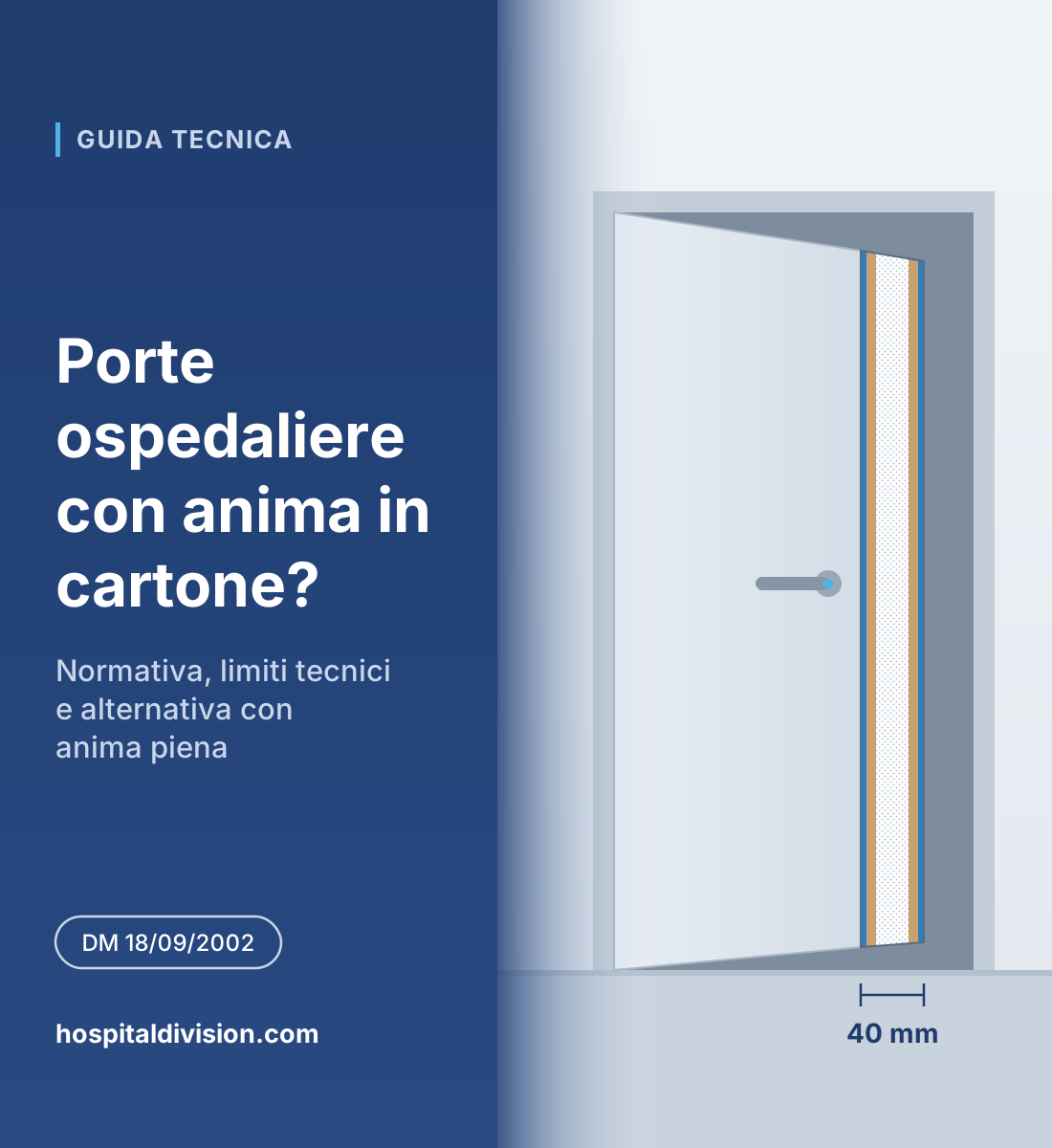
Are doors with a cardboard honeycomb core suitable for hospitals? Regulations, technical limits and why choose a solid-core compound panel.
In requests for quotations for healthcare facilities, hollow-core doors with a cardboard honeycomb core often appear—the classic honeycomb. They are light and inexpensive and widely used in residential buildings and offices. But are they suitable for a hospital ward? Let’s see what the regulations say and what happens in everyday use.
What the regulations say
No Italian standard explicitly forbids doors with a cardboard core in healthcare facilities. Internal doors must, however, meet two groups of requirements.
- Fire prevention. DM 18 September 2002 and subsequent amendments, or alternatively Vertical Technical Rule V.11 of the Fire Prevention Code, sets the reaction-to-fire classes of materials based on the environment. Compartmentation doors must also have certified EI fire resistance. A hollow-core door with a cardboard honeycomb core cannot be an EI door.
- Hygiene and accreditation. Minimum structural requirements (DPR 14 January 1997) and regional accreditation manuals call for washable, disinfectable, and durable surfaces, especially in critical areas.
Cardboard, therefore, is not banned. It is the combination of these requirements with real-world use that makes it unsuitable in a hospital setting.
The limits of cardboard honeycomb in hospitals
- Moisture and disinfection. In hospitals, doors are cleaned every day with water and disinfectants. A damaged edge or an unsealed fixing hole is enough for moisture to reach the cardboard. The cardboard swells, loses strength, and the panel warps.
- Impacts. Beds, stretchers, and trolleys hit doors continuously. With a honeycomb core, the facing has only point support, so it dents and can be punched through.
- Hardware and automation. Hinges, panic bars, door closers, and automation need a solid backing. In a honeycomb panel, screws bite into only a few millimetres of material and over time they lose hold.
- Long-term durability. A door that warps or gets damaged must be replaced earlier than expected. The initial saving turns into maintenance costs and disruption for the ward.
Our choice: solid-core compound panel
Hospital Division doors are made with a 40 mm 5-layer compound panel, with a symmetrical structure:
- 0.9 mm plastic laminate on both faces, smooth, washable, and resistant to detergents;
- MDF under each face, providing stiffness and a solid base for hinges, panic bars, and automation;
- self-extinguishing expanded polystyrene core, with delayed flame spread, Class 1 reaction to fire, with a density of 25 kg/m³. It is solid and light and, unlike cardboard, does not absorb water.
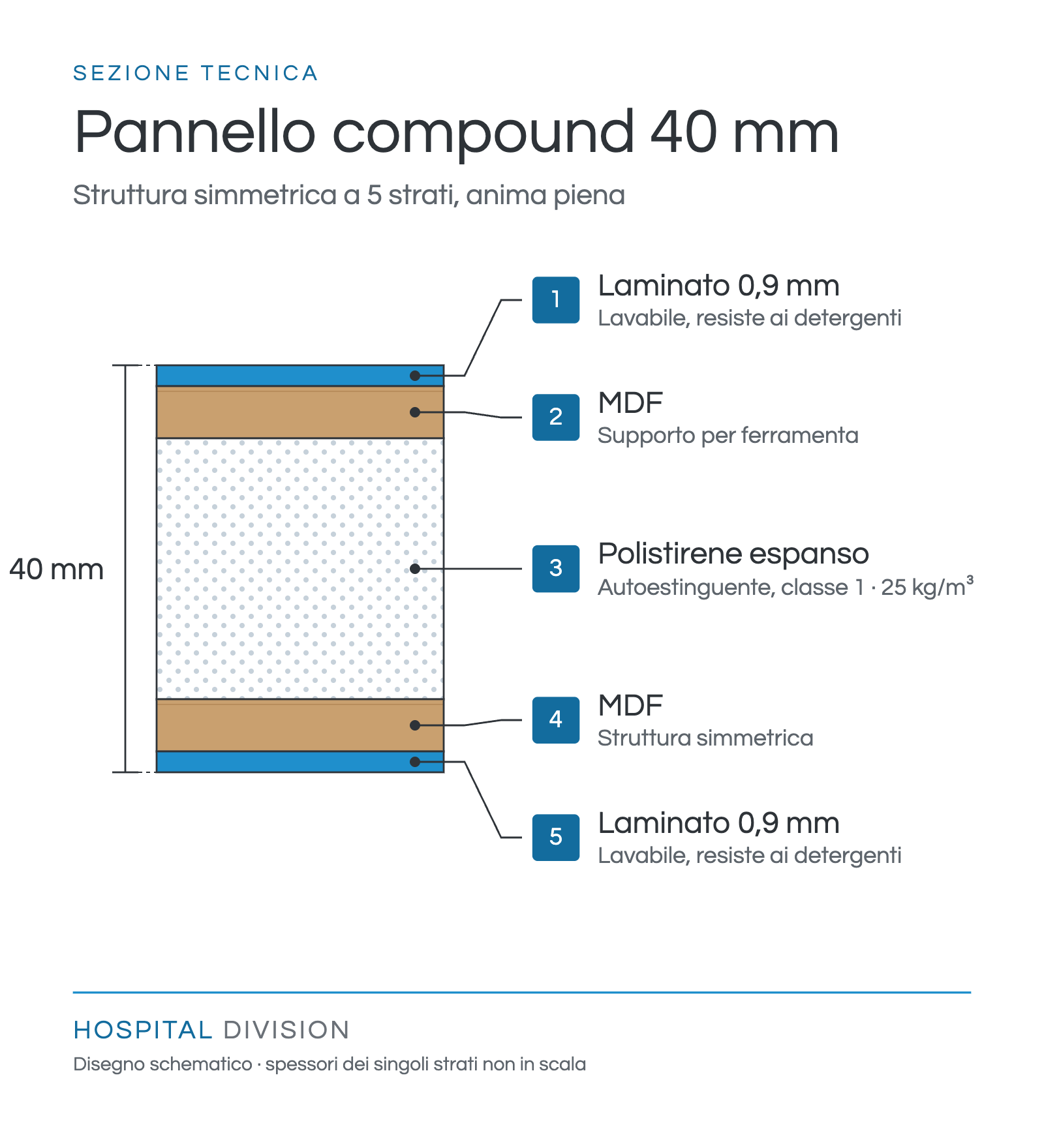
The symmetrical structure balances the stresses between the two faces: the panel stays flat over time and does not warp. The result is a stable, impact-resistant door that retains hardware tightness even after years of intensive use.
Antibacterial handle
The doors are fitted with an antibacterial handle. The handle is the part of the door most often touched by staff, patients and visitors, and therefore one of the most critical for the transmission of infections. An antibacterial finish reduces the growth of bacteria on the surface, supporting standard cleaning and disinfection protocols.
In brief
Door with cardboard honeycomb core
- Core: cardboard honeycomb
- Moisture resistance: low
- Impact resistance: limited
- Hardware and automation holding: limited over time
- Long-term flatness: variable
- Suitable for intensive hospital use: no
Hospital Division door with 40 mm compound panel
- Core: self-extinguishing expanded polystyrene, class 1
- Moisture resistance: high
- Impact resistance: high
- Hardware and automation holding: solid MDF backing
- Long-term flatness: ensured by the 5-layer symmetric structure
- Suitable for intensive hospital use: yes
Do you have a project or a specification to review?
Our technical office is available to designers, companies and hospital technical offices to assess the most suitable solution for each environment. Write to us at info@hospitaldivision.com.